CiteMed Evidence Cloud V6.0.6: Post Market Surveillance Software Release That Closes the Loop
Summary Altus, released in May 2026, made every stage of CiteMed Evidence Cloud faster. AI [...]
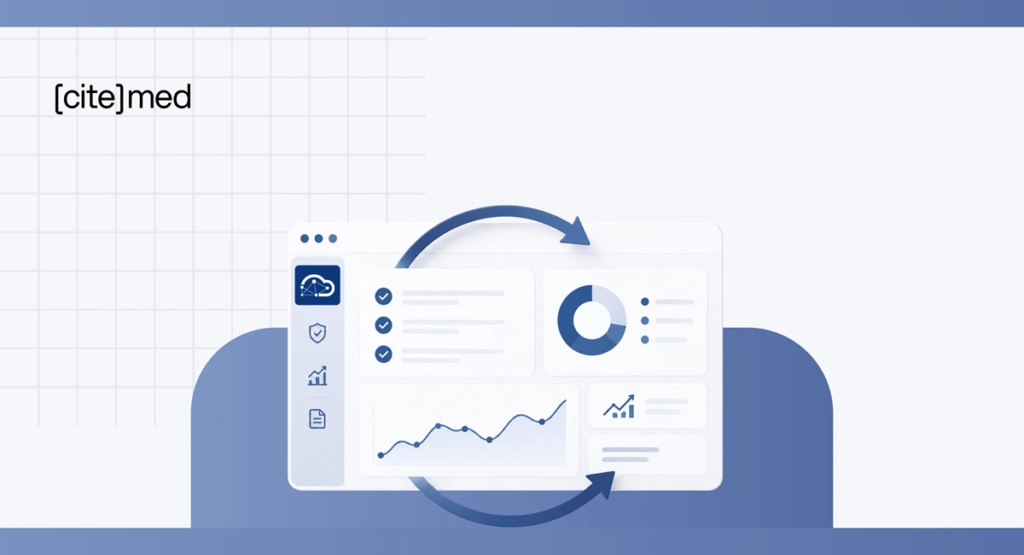


A literature review platform can be full of capable individual features and still leave regulatory teams doing the same reconciliation work by hand between stages: exporting a spreadsheet from screening for the writer to work from, rebuilding an extraction table because a report wants it shaped differently, or re running a PubMed search every quarter because nothing was watching the literature in the meantime.v
V6.0.6 is built on the premise that those handoffs should not need to exist. Evidence enters CiteSource once. It is appraised once. It flows into a report that stays connected to its source data rather than freezing the moment it is published. That report’s conclusions define what Living Reviews and the Vigilance workspace keep watching for going forward, with post market surveillance pms required under EU MDR Article 83 for all classes of medical devices. And when Vigilance surfaces something worth acting on, it is a click back to the specific literature that supports or contradicts it, not a separate system with its own export format and its own version of the truth.
That is the loop: discovery feeds appraisal, appraisal feeds reporting, reporting feeds monitoring, and monitoring sends you back to discovery with sharper search terms than you started with. V6.0.6 is the release where the seams between those stages closed.
Altus proved that each stage of a literature review could run considerably faster. Abstract screening sped up three to five times. Extraction configuration time dropped 40%. Reference import success rose from 85% to 98%. Those are real, measurable gains, but speed inside a single stage does not resolve what happens between stages.
Regulatory teams under EU MDR and IVDR do not run a literature review once and file it away. A Clinical Evaluation Report has to stay current for the life of the device. Post market surveillance has to be active and continuous rather than a quarterly catch up. PMCF obligations assume this is a post-CE-marking clinical data collection process, that its outputs feed into the Clinical Evaluation Report, and that the literature review, the CER, and the vigilance function are all working from the same evolving clinical evidence base, not three separate ones that get reconciled by hand right before a Notified Body audit.
That reconciliation work is exactly where most platforms, and most home built spreadsheet processes, break down. A screening decision does not carry its reasoning into the report narrative. A report does not tell the monitoring search what to watch for next. A vigilance signal does not know which CER section it should be checked against. Each stage is well built on its own and disconnected from the next one.
V6.0.6 closes those gaps directly, with an assistant that can act across all of them rather than living inside a single screen.
The loop starts in CiteSource, rebuilt end to end in this release. The new table layout, filters slide out, and devices and claims filter tree mean a reference is not simply filed away. It is organized against the devices and claims it touches the moment it lands. Clicking into a reference opens a full detail view, metadata, an inline PDF viewer, extractions, tags, and a per article audit log all in one place, rather than a thin modal that closes as soon as you need the next piece of information.
Smart Lists are what let this stage feed the next one automatically. A list can be built the traditional way, with conditions, AND/OR groups, and nested logic, or described in plain language for Clio to turn into a rule. Either way, membership updates itself as the library changes. A list built for everything relevant to a device’s PMCF file does not need to be rebuilt each quarter. Ongoing monitoring can also be structured by intended use and risk class so PMS stays proportionate to the device’s classification. Whatever Living Reviews finds next month already lands there, sorted.
Layout aware extraction is now the standard path for every article, with a vision pass reserved for complex tables, and it runs on dedicated capacity so it no longer queues behind batch work. When teams configure review methods here, they can preserve a predefined search protocol with exclusion criteria and coverage across multiple databases for traceable reuse, since systematic reviews must follow predefined search protocols and criteria. The more consequential change is what happens to the extracted data afterward. Outcome measures flow from a protocol panel through a per domain table straight into report output, with no spreadsheet rebuilt by hand in between. Claims carry their supporting evidence forward, with a confidence score that reflects both how well the evidence supports the claim and how strong that evidence is on its own.
This is where the release changes the most, and the change is easy to describe even though it was not easy to build. Reports used to come out of a fixed template and, once generated, were effectively finished. They now run on the same document engine as CERs: versioned, commented on, with per section diffs and the ability to restore an earlier version, which supports CER maintenance under The MEDDEV 2.7/1 revision 4 guidelines and broader mdr compliance expectations. A single document can cover an entire device family, with sections shared across devices and sections that fork off for the one device that needs to diverge, while preserving the technical documentation notified bodies expect to review.
That matters for the loop because new evidence, from Living Reviews or a Vigilance signal, can land as a tracked edit to a report that already exists. It does not force a new document that needs to be re-reviewed and re-approved from the first page. That is the difference between a report that stays current and one that is a snapshot you keep retaking.
Altus shipped the foundation of the Vigilance module: intake and basic lifecycle tracking. V6.0.6 gives it an operational home to work from every day: an Overview with a PRISMA style project flow and funnel counts across every adverse event source, plus a Reports tab and workspace that centralize complaints, clinical records, and other data sources for systematic data collection; a Screen Events view with bulk state changes to review adverse events; manual event logging for serious incidents; an AI generated Post Summary; and a Reports tab that produces PSUR output through the same document engine as everything else. Analytics also help identify safety trends and performance issues to support ongoing safety and performance.
That last part is what carries the loop back to the start. A PSUR built this way can point directly at the literature and claims it summarizes, the same evidence that entered the library, was appraised, and became a report weeks or months earlier, while also supporting automated regulatory reporting for EU MDR and FDA workflows. And when Vigilance surfaces a pattern worth watching, it can become a new or sharper Living Review, sending the cycle back to discovery with better information than it began with.
None of this would feel connected without something able to move across all of it. Clio is built into the platform and knows how to operate it: find a review, expand a PICO, run a search, screen a batch of articles, save appraisal fields, draft a report, and support broader risk management alongside quality-facing processes, including work that can connect with quality management systems to strengthen compliance. It understands the way reviewers actually refer to their work, “the MitraClip review” rather than a record ID, and before it takes any consequential action, it shows the plan first. That plan can be edited, confirmed, or denied, and whatever Clio ends up doing is written to the audit trail the same way any reviewer’s action would be.
That is the practical meaning of working with you, not just for you. Clio does not only make one screen faster. It can carry a piece of evidence through two or three stages of the cycle inside a single conversation, with a reviewer still approving each step along the way, which also supports proactive risk management.
The failure point is almost never inside a single stage. It is between them. A screening decision gets made with sound reasoning that never reaches the report narrative, so the writer reconstructs the logic later by re reading the abstract. An extraction gets shaped to fit one report and has to be manually reshaped for the next report covering the same device. A report gets finalized and then quietly forked by hand as new evidence trickles in, until nobody is entirely sure which version is current.
The costliest version of this shows up in post market work: a signal surfaces in Vigilance that the literature review had already hinted at, months earlier, in a system nobody thought to check. When that happens, it may change the device’s risk profile and should feed back into the regulatory strategy that manufacturers use to document and respond to the issue.
Set up Smart Lists for every device family before your next review cycle starts rather than partway through it, so anything Living Reviews surfaces already lands somewhere useful and continuous monitoring helps maintain a current state of the art view for each device family, defining current accepted clinical practices.
Move existing reports onto the document engine rather than reserving it for new ones. Version history is only as valuable as how early it starts, and a report that has been on the new engine since day one is a far better answer when a Notified Body asks how a conclusion evolved.
Give Clio smaller tasks first, summarizing search results or expanding a PICO, before handing it something higher stakes like screening or drafting a report section. Confidence in the plan and confirm pattern builds quickly once a team has watched it work on something low stakes, and that context is crucial for demonstrating device safety and efficacy.
Stop treating Vigilance and the literature module as two systems that happen to share a login. Point your Post Summary output at the same device family structure your CERs already use, so a signal and a claim can sit next to each other rather than requiring translation between two different structures, which supports review of the available evidence for ongoing device safety.
| Dimension | Altus (May 2026) | V6.0.6 (May, Aug 2026) |
|---|---|---|
| Primary focus | Making each stage faster | Making the stages hand off to each other |
| AI’s role | Suggests a decision, explains the reasoning | Operates the platform across stages, with a plan the reviewer approves first |
| Reports | Generated once from a fixed template | Living documents, versioned and continuously updatable |
| Vigilance | Foundation: intake and lifecycle tracking | Full workspace: funnels, bulk actions, PSUR output |
| Reference library | Existing structure, faster import | Rebuilt layout, Smart Lists, full article detail view |
| Continuous monitoring | Living Reviews introduced | Living Reviews feeding directly into reports and Vigilance |
| Handoffs between stages | Largely manual | Mostly automatic |
| Audit trail | Per decision logging | Logging across every stage, including Clio’s actions |
Closing the loop: The point at which discovery, appraisal, reporting, and post market monitoring feed each other automatically, so evidence entered once does not require manual re entry, reshaping, or reconciliation later in the cycle.
Clio: CiteMed Evidence Cloud’s platform wide AI assistant. Clio can operate the literature review and Vigilance workflows in plain language, presenting a plan for consequential actions before it runs them.
Living document: A report or CER built on CiteMed’s document engine rather than generated from a fixed template. Living documents support versioning, threaded comments, per section diffs, and restoration to a prior version.
Smart List: A reference list defined by a rule, built visually or generated from a plain language description, whose membership updates automatically as the reference library changes.
Living Reviews: Continuous monitoring of literature databases against a defined search, supporting systematic literature monitoring across medical literature and medical device literature, surfacing new matching articles as they publish rather than requiring a manual re run of the search. Systematic literature reviews also help establish the State-of-the-Art for devices.
Vigilance workspace: The operational home for post market surveillance in CiteMed Evidence Cloud, covering adverse event screening, manual event logging, AI generated post summaries, and PSUR ready reporting.
PSUR: Periodic Safety Update Report. A recurring post market surveillance document required under EU MDR that summarizes safety data, including literature, vigilance, and PMCF findings, over a defined reporting period.
The gap between tools that are fast and a process that actually works is rarely about a missing feature. It shows up in the few minutes right after a reviewer finishes one task and starts the next, in whether what they just produced is immediately usable in its new context or needs to be exported, reformatted, and re-explained first. Every one of those handoffs is a place where evidence quietly degrades: a piece of reasoning that does not survive the transition, a version forked without anyone noticing, a signal sitting in one system while the literature explaining it sits in another, and conclusions about safety and performance becoming harder to preserve for patients across the entire lifecycle. This release went back through every one of those handoffs deliberately. Clio, the document engine, and the Vigilance workspace matter less on their own than the fact that they now hand work to each other correctly.
Special thanks to the pilot customers who kept telling us, plainly, exactly where the process still broke.
Altus focused on making individual stages of the literature review and post-market process faster and more capable: quicker screening, faster extraction, a first version of Vigilance. V6.0.6 focuses on the connections between those stages and better supports medical device manufacturers running post-market workflows across the entire evidence cycle, so output from one, a screening decision, an extraction, a report conclusion, flows into the next without manual re-entry. Altus made the parts better. V6.0.6 made them work as one system.
Clio can act at any stage of the cycle in plain language: finding a review, expanding a PICO, refining a literature search, supporting a systematic literature workflow, evaluating a search strategy, screening articles, saving appraisal fields, and generating reports. It understands context, what record and screen a reviewer is looking at, and shows a plan before doing anything consequential, which can be edited, confirmed, or denied. Every action is written to the audit trail.
Reports run on the same document engine as CERs, supporting versioning, threaded comments anchored to specific text, and per-section diffs. New evidence from Living Reviews, a Vigilance signal, ongoing PMCF activities, or targeted PMCF studies can be incorporated as a tracked edit to an existing report rather than requiring a full new document to be generated and re-approved from the start, which helps keep clinical evaluation conclusions current.
Yes. Vigilance projects share the same document engine used for CERs and literature reports, and Vigilance’s own reporting, PSUR output, AE Mini Reports, and Appendix E2 exports can reference the same devices, claims, literature, clinical investigation outputs, clinical trials, and equivalent device comparisons tracked elsewhere in the platform rather than functioning as a separate record set.
Existing reports can be moved onto the document engine to gain versioning, diffs, and living document status. The sooner a report starts accumulating version history on the new engine, the more complete its record is when that history matters, such as during a Notified Body review, and that living history also helps defend updates to the PMCF plan and clinical evaluation plan.
If your literature review, CER, and post market surveillance still live in three places you reconcile by hand before an audit, V6.0.6 is built to change that for medical device companies managing ongoing safety and performance obligations. We would be glad to walk through Clio, the rebuilt Reference Library, or the new Vigilance workspace and show exactly where the loop closes for a review like yours, with technical documentation ready for notified bodies. Contact us.
Literature reviews, CERs, post-market surveillance — in one platform.