How to Conduct an EU MDR Literature Review: A Step-by-Step Guide to Submission-Ready Evidence
An EU MDR literature review is the systematic, documented search and appraisal of published clinical [...]

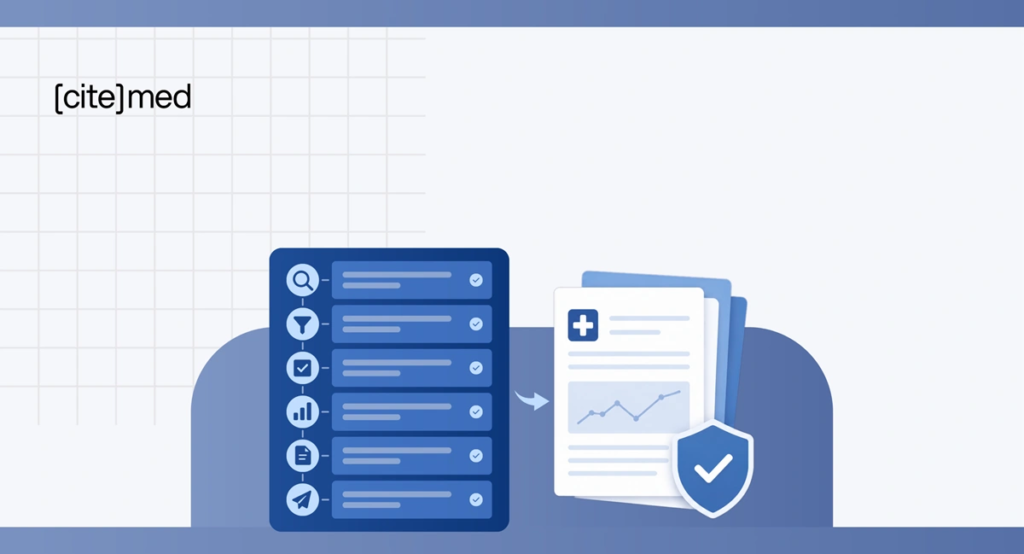


An EU MDR literature review is the systematic, documented search and appraisal of published clinical data that supports a device’s clinical evaluation. Article 61(3)(a) requires the clinical evaluation to be based on a critical evaluation of the relevant scientific literature, and Annex XIV Part A sets out how. In practice, the review runs in seven steps: write a search protocol, search multiple databases, deduplicate, screen titles and abstracts, review and appraise full texts, document selection in a PRISMA flow diagram, and write the literature report that feeds the CER. Notified bodies judge it less on how much evidence you found than on whether another reviewer could reproduce exactly how you found and selected it.
Annex XIV says what a literature review must achieve but not how; notified bodies now judge the method, the documentation, and the traceability as much as the evidence itself.
Starting an EU MDR literature review can feel overwhelming. Annex XIV outlines what manufacturers must achieve, but provides little guidance on how to build a process that holds up to Notified Body scrutiny.
Regulatory expectations around transparency, reproducibility, and methodological defensibility continue to increase. Reviewers assess not only what evidence was found, but how it was searched, screened, evaluated, interpreted, and integrated into clinical evaluation activities.
When a literature review lacks clear methodology, traceable screening decisions, or alignment with clinical evaluation objectives, it weakens the defensibility of the clinical evidence package, even when the team has identified large volumes of literature. Notified Bodies now expect structured workflows, consistent documentation, and clear reviewer accountability throughout every stage of the MDR literature review process.
Developing a submission-ready EU MDR literature review requires more than performing database searches. It means establishing a structured and reproducible process that supports evidence traceability from protocol development through to final reporting.
This guide walks through the MDR systematic literature review process step by step, covering protocol development, database searching, evidence screening, critical appraisal, PRISMA documentation, and preparation of a submission-ready literature review report.
The MDR requires a systematic, objective, and reproducible review that identifies, appraises, and analyses all relevant clinical data, with MEDDEV 2.7/1 Rev 4 still the main methodological reference.
Under EU MDR 2017/745, literature reviews must follow a systematic, objective, and reproducible methodology that supports the clinical evaluation process. Annex XIV Part A requires manufacturers to identify, appraise, and analyse all relevant clinical data to demonstrate device safety, clinical performance, clinical benefit, and benefit-risk profiles in support of regulatory compliance.
A systematic literature review is critical to achieving compliance and to supporting regulatory submissions and technical documentation.
MEDDEV 2.7/1 Rev 4 remains a key methodological reference for literature review and clinical evaluation activities. Notified Bodies assess whether search strategies, screening decisions, evidence appraisal methods, and documentation practices align with established clinical evaluation principles. Manufacturers also struggle to determine the amount of clinical evidence needed for compliance, especially because the MDR removes grandfathering and all devices require recertification, which contributes to long approval timelines.
MDCG 2020-13, the template notified bodies use for their clinical evaluation assessment report, directs them to check the literature search methodology and documentation specifically. A gap in how the search was run or recorded is therefore a direct audit finding, not just a quality issue.
Define the device scope, research questions, and inclusion and exclusion criteria in a written protocol before any search is run.
Before performing any database searches, establish a literature search protocol that defines how evidence will be identified, screened, evaluated, and documented. This improves reproducibility, reduces reviewer bias, and demonstrates methodological consistency during Notified Body review.
Begin by clarifying the device scope including the subject device, intended purpose, target patient population, indications for use, risk profile, the relevant medical field, and the clinical background needed to define the state of the art. Defining these elements early determines which evidence sources are clinically relevant and which fall out of scope.
State-of-the-art searches establish the current clinical and technological landscape, including generally accepted treatment options and standards. SOTA reviews are essential for compliance with EU MDR and IVDR. Equivalence searches evaluate evidence from comparable devices that may support the device under evaluation. Searches may also assess an equivalent device and similar competitor devices when relevant to the clinical evaluation. This includes understanding current treatment approaches, comparable technologies, clinical practice standards, and competing therapeutic options relevant to the intended purpose.
Many MDR literature review workflows incorporate the PICO framework to structure clinical questions by defining the target population, intervention or device, comparator context, and intended outcomes. This approach aligns with expectations outlined in MEDDEV 2.7/1 Rev 4. Predefined research questions should guide the search and evidence synthesis, and from these questions, teams should establish predefined inclusion and exclusion criteria covering patient populations, study designs, publication dates, language, device relevance, comparator relevance, and clinical outcomes. Defining these criteria before searching begins reduces subjective screening decisions, improves reviewer consistency, and strengthens audit readiness.
Review objectives should reflect the specific evidence requirements of the clinical evaluation. Some reviews focus on demonstrating safety and performance, while others emphasise benefit-risk evaluation, long-term outcomes, PMCF integration, or specific concerns identified through post-market surveillance activities. Objectives may also include demonstrating clinical benefit, maintaining benefit-risk profiles, and integrating new clinical data over the device lifecycle. Post-market objectives should also align with risk management; a PMS system must be maintained for each medical device, and every device needs a PMCF plan or a documented justification for not having one.
For a full sample protocol structure and guidance on when to update it, see Literature Search Protocol for EU MDR.
Search several databases with documented, reproducible search strings, and add supplementary sources such as trial registries, vigilance databases, and grey literature.
Perform structured database searches to identify potentially relevant evidence from medical literature, scientific literature, and published literature. Select databases that align with the device type, intended purpose, therapeutic area, and clinical questions, and that capture all relevant data. Commonly used databases include PubMed, Embase, and the Cochrane Library, along with specialty-specific databases relevant to the device.
Search strategies combine predefined keywords, subject headings, device terminology, clinical conditions, synonyms, and outcome-related terms using Boolean operators.
EU MDR literature reviews often require supplementary evidence sources including conference abstracts, clinical trial registries, grey literature, vigilance databases, safety communications, PMCF findings, and manufacturer complaint data. Performance evaluation for an in vitro diagnostic may also require targeted searches for scientific validity, clinical performance, and evidence used in performance evaluation reports.
Document databases searched, search dates, complete search strings, applied filters, search limitations, and the rationale for evidence source selection. Search documentation must be sufficiently detailed to allow another reviewer to reproduce the search independently, while also supporting regulatory submissions and inclusion in technical documentation.
| Database | Typical Use |
|---|---|
| PubMed | Biomedical and clinical literature |
| Embase | International biomedical and pharmacological literature |
| Cochrane Library | Systematic reviews and evidence syntheses |
| ClinicalTrials.gov | Ongoing and completed clinical studies |
| Specialty-specific databases | Device-specific or therapeutic-area evidence |
If you sell in markets outside the EU, see Literature Search for EU MDR and Other Regions for how to design one search that also covers FDA, UK, and other regulators.
Consolidate records from every database into one dataset and document how many duplicates were removed and how.
Import retrieved records into a literature review platform or reference management system. Records from multiple databases are consolidated into a single dataset before screening begins.
Because the same publication may be indexed across multiple databases, duplicate records must be identified and removed before screening. Accurate duplicate management maintains reliable PRISMA counts and ensures transparency throughout the review process. Document the number of duplicate records removed and the methodology used to identify them.
Apply the protocol’s inclusion and exclusion criteria consistently to every title and abstract, and record each decision.
Screen titles and abstracts against the predefined inclusion and exclusion criteria established in the review protocol. Publications clearly irrelevant to the intended purpose, device scope, target population, or clinical objectives are excluded before progressing to full-text assessment.
Consistent application of inclusion and exclusion criteria is critical under EU MDR. Inconsistency introduces selection bias, reduces reproducibility, and weakens the overall defensibility of the evidence review. For a detailed overview of the most common literature review challenges that arise during screening and appraisal, see our dedicated article on this topic.
Extract data from each full text with a structured form, appraise its quality and relevance, and interpret it against the current state of the art.
Studies passing title and abstract screening proceed to full-text review. Assess each publication against the predefined clinical and methodological requirements established in the review protocol, determining whether it provides clinically relevant data for the subject device or an equivalent device, including any clinical investigation evidence.
Extract key study information using a structured data extraction form covering study characteristics, patient populations, device details, comparator information, safety outcomes, clinical performance, performance data, adverse events, follow-up duration, and reviewer comments.
Perform critical appraisal to assess the quality and relevance of evidence, including evaluation of study design, methodological limitations, risk of bias, endpoint selection, statistical robustness, patient population relevance, and overall applicability to the intended purpose of the device. MEDDEV 2.7/1 Rev 4 provides detailed guidance on appraisal and weighting methodologies that align with Notified Body expectations.
Interpret evidence within the broader context, considering current treatment standards, clinical practice guidelines, accepted standards within the medical field, comparable technologies, and competing therapeutic approaches. Article 61 and Annex XIV of the EU MDR require clinical evidence to be evaluated against the current state of the art, including the medical alternatives available to patients.
Maintain a clear audit trail throughout. Document extraction decisions, appraisal outcomes, reviewer comments, and exclusion rationale to strengthen traceability and support alignment between evidence appraisal and final CER conclusions.
Document the study selection process using a PRISMA flow diagram. Under EU MDR, PRISMA-style documentation demonstrates methodological rigour and provides a clear audit trail of how evidence was identified and selected.
Use the current PRISMA 2020 statement and flow diagram template rather than the older 2009 version. The 2020 template separates records found through databases and registers from those found through other methods, which maps neatly onto the supplementary sources in Step 2.
The PRISMA flow diagram captures key metrics from each stage of the review:
Numbers reported in the PRISMA diagram must align with search outputs, screening logs, exclusion records, and final evidence tables.
| Issue | Potential Impact |
|---|---|
| Inconsistent record counts | Reduced traceability and reviewer confidence |
| Undocumented exclusion decisions | Difficulty justifying evidence selection |
| Missing duplicate removal records | Misalignment between search and screening outputs |
| Incomplete reporting of evidence sources | Reduced transparency |
| PRISMA counts that do not match evidence tables | Increased likelihood of reviewer questions |
The report must show how evidence was found, screened, appraised, and interpreted, present favourable and unfavourable data, and link clearly to the CER’s conclusions.
Develop a structured, submission-ready literature review report that supports regulatory compliance and submissions by clearly demonstrating how evidence was identified, screened, appraised, interpreted, and incorporated into clinical conclusions supporting the device’s safety, performance, and benefit-risk profile.
| Section | Purpose |
|---|---|
| Review objective and scope | Defines the clinical questions and evidence requirements |
| Search methodology | Documents databases, search strings, dates, and limitations |
| Screening methodology | Describes inclusion and exclusion criteria and screening processes |
| PRISMA flow diagram | Demonstrates evidence selection and record progression |
| Evidence appraisal | Summarises study quality, relevance, and methodological considerations |
| Evidence tables | Presents extracted study data in a structured format |
| Clinical interpretation | Explains how findings support safety, clinical benefit, clinical performance, and benefit-risk profiles |
| Conclusions | Summarises the overall strength of the evidence base |
Present evidence objectively. EU MDR 2017/745 requires manufacturers to consider both favourable and unfavourable data when generating clinical evidence.
Link evidence findings clearly to final clinical conclusions. Review outputs should support the conclusions presented in the Clinical Evaluation Report and lifecycle evidence activities, including PMS assessments, PMCF planning, state-of-the-art evaluations, and ongoing benefit-risk monitoring. They should also support technical documentation, performance evaluation reports where applicable, and ongoing risk management.
Most literature review deficiencies are about missing documentation and traceability, not missing evidence.
Most literature review deficiencies identified during Notified Body review relate to methodology transparency, documentation consistency, and workflow traceability rather than the absence of evidence itself, and weak processes in these areas can significantly delay compliance under the MDR.
| Challenge | Potential Impact |
|---|---|
| Undocumented exclusion decisions | Reduced transparency and difficulty justifying evidence selection |
| Missing databases or evidence sources | Incomplete evidence identification and potential evidence gaps |
| Inconsistent PRISMA counts | Reduced traceability and reviewer confidence |
| Poorly documented searches | Reduced reproducibility and weaker audit readiness |
| Inconsistent screening decisions | Reduced reviewer consistency and accountability |
| Weak evidence traceability | Difficulty reconstructing evidence pathways |
| Limited state-of-the-art evaluation | Incomplete clinical and competitive context |
| Outdated evidence sources | Reduced relevance to current clinical practice standards |
| Weak PMS or PMCF integration | Gaps in lifecycle evidence strategy |
| Insufficient reviewer oversight | Increased variability and reduced methodological consistency |
| Missing rationale documentation | Reduced transparency and weaker regulatory defensibility |
For a full breakdown of the most common reasons Clinical Evaluation Reports are rejected during Notified Body review, see our dedicated article on this topic.
For many manufacturers the literature is most or all of their clinical data, and a good review also informs device development, PMS, and PMCF.
Want to know what the most commonly criticized document in an MDR submission is?
Your clinical literature review.
For many medical device manufacturers, the literature search represents the majority, if not all, of the clinical data they collect on their devices during device development and subsequent clinical evaluation updates. With it, it is possible to demonstrate and critically evaluate the safety and efficacy of their device during clinical evaluation.
Even for companies that have performed clinical trials, a literature search still ensures a summary of the valuable clinical data regarding the different aspects of their device and its performance.
Lastly, and maybe most importantly, the literature search is mandatory for clinical evaluation reports under the EU MDR and will help determine if your medical device receives a CE mark.
A good literature search provides the following:
It should quickly summarize the maximum amount of published literature.
A well-organized and thorough literature search provides manufacturers with critical information on who else has attempted to solve this problem, which approaches were taken (similar devices on the market), how they were received in the marketplace, and if they were effective and safe.
It can also reveal to the manufacturer whether other available products may be better suited to solve the problem than the device they’re attempting to put on the market.
A thorough literature search will also help you create an excellent systematic process that will set you up for future documentation updates, reducing future workload.
A literature review serves many purposes in the medical device development process, from informing the R&D team about what has been done before to understanding how a new device fits into the market and helping determine whether a project is worth pursuing.
The literature review supports both pre-market clinical evaluation and the device’s ongoing post-market obligations, and the clinical evidence gathered can significantly help you design your medical device’s post-market surveillance program. It also helps support claims made by manufacturers about their products, including their intended use, safety, and effectiveness.
Search more than one database, test your terms with a preliminary search, write the protocol before you start, and use Boolean operators, filters, and a citation manager.
Not all databases are equal, and they will not necessarily yield the same results for your literature review. Searching just one isn’t enough: to find articles and research examples relevant to your device, you need to search multiple databases.
For example, using the (unfiltered) search term “Silk fibroin AND (dermal OR filler OR “dermal filler” OR “soft tissue augmentation”) will yield three results in PubMed, 16,700 results in Google Scholar, and 181 results in LIVIVO.
Some of these differences are due to how the search engines work, while others are due to different publications available in each database.
If you are going after a CE Mark under EU MDR, then you’ll want to select databases that give you a comprehensive and global (with a EU focus) result set.
You should always do a preliminary search to get an overview of the information and publications and test the waters of your search terms. Get a feel for the task.
Once you have determined what you are looking for and how to get there, write a detailed plan for the search. Include search terms, inclusion/exclusion criteria, key concepts, the databases you will search and what tools you will use for your search.
You are writing a recipe for your search you can follow when you start. This recipe becomes the literature search protocol.
There is a lot of meticulous detail work and moving parts to the literature search, and there is no need to complicate matters for yourself – use as many digital tools to make your life easier as possible. Download your search results, use a citation manager, and ensure you’re using the right programs when reviewing your data results.
The team at CiteMed has spent years refining and perfecting our Systematic Literature Review Software platform so that it’s easy to use, and can save you massive amounts of hours per review project.
Operators allow you to narrow your literature review to focus on only the publications relevant to you and save you hours. Likewise, your search can be widened if you are not getting enough results.
The most well-known operators are AND, OR, and NOT. Use them wisely.
Most literature reviews have some search restrictions in place. It can be a time limit, i.e., only doing literature searches for the last five years. It can be a language (no use getting results in Japanese if you can’t understand them), a medical discipline, or the type of publication you are looking for.
Every database will have filters you can use to refine and narrow down your search – make sure to use them as much as possible. It is your most straightforward tool to obtain the results you need. Any filter you apply, such as a date range or language limit, has to be written into the protocol and justified. A language filter in particular can exclude relevant European studies, which is a common notified body question.
Automation helps with the volume problem, but under the MDR every automated step still needs human verification and a documented validation.
Several million scientific articles are published every year, and the volume keeps growing.
This information explosion makes it increasingly difficult for researchers to keep up with the latest field developments. For many regulatory people and medical writers, it is simply impossible to read through all the search results carefully to find relevant information for clinical evaluation reports (CER).
Several automated programs with integrated artificial intelligence and machine learning allow users to create labels, filters for the data extraction process, inclusion criteria & research questions customization, and indexing to balance precision and recall.
Every stage, from protocol to report, contributes to how defensible the clinical evidence package is.
From protocol development and database searching through to screening, critical appraisal, PRISMA documentation, and final reporting, each stage of an EU MDR literature review contributes to the quality and defensibility of the clinical evidence package. Notified Bodies expect reviews to be transparent, reproducible, and supported by clear documentation in line with MEDDEV 2.7/1 Rev 4 and EU MDR 2017/745. A well-executed literature review establishes a reliable foundation for CER development, PMS activities, PMCF planning, and ongoing clinical evidence generation throughout the device lifecycle. Stringent MDR requirements, recertification of legacy devices, and long approval timelines make a proactive documentation approach especially important.
If you are preparing a literature review for a Clinical Evaluation Report or post-market surveillance update and want support building a structured, audit-ready process, Citemeds can help. Our team works with medical device manufacturers to design and conduct literature reviews that meet EU MDR expectations from protocol development through to final reporting, including support for technical documentation and regulatory submissions. Get in touch to discuss your requirements.
These supporting guides go deeper on the protocol, the search itself, and the underlying MEDDEV guidance.
Common questions on what an EU MDR literature review needs, which databases to use, PRISMA, and appraisal.
An EU MDR literature review must include a documented search protocol defining the review objective, databases, search terms, and inclusion and exclusion criteria; structured database searches across sources such as PubMed, Embase, and the Cochrane Library; systematic title and abstract screening with documented decisions; full-text review with critical appraisal of included studies; PRISMA flow diagram documentation; and a structured literature review report linking evidence findings to clinical evaluation conclusions. The process should also be driven by predefined research questions and a literature search protocol. Each stage must be transparent, reproducible, and traceable to support Notified Body assessment under EU MDR 2017/745.
The minimum database set typically includes PubMed, Embase, and the Cochrane Library. Depending on the device type and therapeutic area, additional specialty-specific databases may also be required. Supplementary evidence sources such as ClinicalTrials.gov, grey literature, vigilance databases, and PMCF findings should also be considered. The rationale for database selection should be documented within the search protocol and sufficiently detailed to allow another reviewer to reproduce it independently. Database selection should be sufficient to capture all clinical data relevant to the review objectives.
A PRISMA flow diagram is a visual summary of how records progressed through each stage of the literature review, from initial identification through to final inclusion. While EU MDR 2017/745 does not explicitly mandate PRISMA, Notified Bodies widely expect it as a standard for demonstrating transparency and reproducibility. The diagram should accurately reflect the number of records identified, deduplicated, screened, excluded, and included, with all counts consistent across search outputs, screening logs, and evidence tables.
The most common reasons include undocumented exclusion decisions, missing or poorly justified database selection, inconsistent PRISMA counts, weak search documentation, inconsistent application of inclusion and exclusion criteria, inadequate state of the art assessment, lack of clinical background depth, weak linkage to risk management, and insufficient linkage between evidence findings and clinical conclusions. For a full breakdown see our article on reasons Clinical Evaluation Reports are rejected.
Critical appraisal is the structured process of evaluating the quality, relevance, and methodological robustness of studies included in a literature review. In a medical device context this includes assessing study design, risk of bias, endpoint selection, statistical robustness, patient population relevance, follow-up duration, and overall applicability to the device’s intended use. MEDDEV 2.7/1 Rev 4 provides the primary methodological framework for appraisal in EU MDR clinical evaluation. Critical appraisal is one of the most frequently scrutinised aspects of literature review methodology during Notified Body assessment.
Article 61(3)(a) requires the clinical evaluation to be based on a critical evaluation of the relevant scientific literature on the device’s safety, performance, design, and intended purpose. Annex XIV Part A requires this to follow a defined, methodologically sound procedure set out in a clinical evaluation plan, and to consider both favourable and unfavourable data.
Follow the seven steps in this guide: protocol, database searches, deduplication, title and abstract screening, full-text review and appraisal, PRISMA flow diagram, and the literature report. The protocol comes first and is fixed before any searching, because it is what makes the review reproducible.
Yes. Every device, including Class I, needs a clinical evaluation, and the literature review is one of its required inputs. The depth scales with the device’s risk and novelty, and for many well-established lower-risk devices, the literature is most of the clinical evidence.
It becomes a cycle. The review is updated with new literature at each CER update, using the same protocol so results are comparable. See Literature Search Protocol for EU MDR for update frequencies and triggers.
The method is the same, but IVDs are evaluated through performance evaluation under the IVDR, so the searches target scientific validity, analytical performance, and clinical performance rather than clinical outcomes alone.
Not quite. The search is the act of finding the records; the review is the screening, appraisal, and interpretation of what you found. Many teams use the terms interchangeably. See Literature Search for EU MDR and Other Regions for the search itself.
Literature reviews, CERs, post-market surveillance — in one platform.