Go Live Fast: How CiteMed Gets Teams Up and Running in Three Weeks

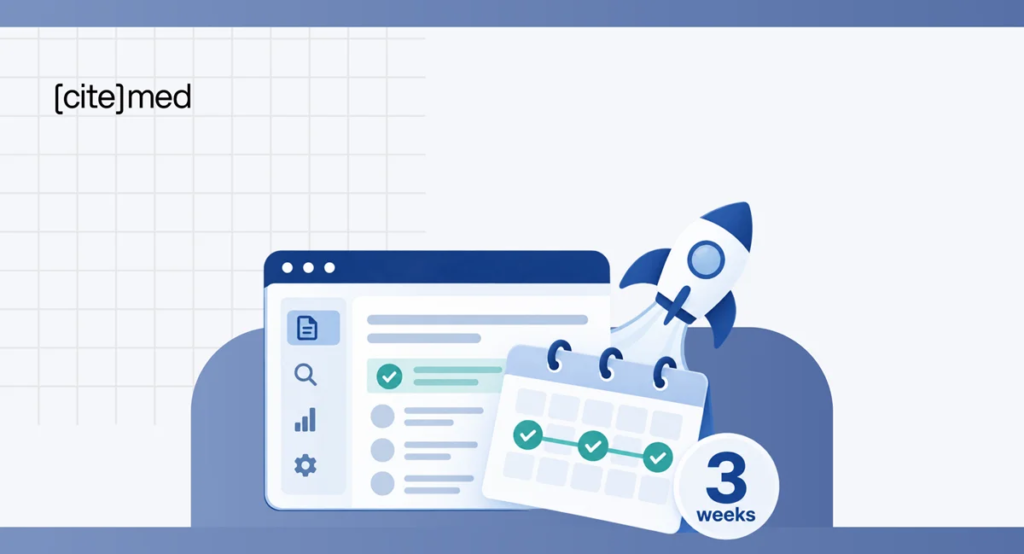

At CiteMed, onboarding is called Activation. It is a short, guided process that typically gets your team working in Evidence Cloud in about three weeks, depending on how quickly your documents come in. Your devices, workflows, templates, and reference libraries are configured before your team sees the system. Training is shaped around how your team actually works, not a generic script. And support does not disappear after go-live.
This article walks through what CiteMed Activation looks like, week by week, and what it means for teams who are mid-cycle on a submission and wondering whether now is the right time to make the switch.
CiteMed Activation typically takes three weeks from contract signature to go-live, depending on how quickly your team can share the necessary documents. The three-week timeline breaks down as follows:
Week 1 is about alignment. You meet your dedicated Customer Success Manager, hold your kickoff call, and exchange onboarding documents through the CiteMed portal.
Week 2 is about setup. CiteMed configures your Evidence Cloud environment in the background, including your devices, users, permissions, CER templates, workflows, and reference libraries. Your team keeps working while this happens.
Week 3 is about training and go-live. With your environment ready, your CSM walks you through the configured system, training is delivered by role and module, and your team leaves ready to start a review and generate a report.
For regulatory teams managing active EU MDR submissions, the perceived risk of switching software for literature review is one of the most common reasons teams delay making a change they know they need to make. The concern is not about the destination. It is about the transition.
The specific fears are familiar. Writers pulled off active CERs to learn a new platform. Reference libraries that need to be rebuilt from scratch. Workflows that need to be reconfigured. A months-long IT project that consumes the team’s attention at exactly the wrong time. And at the end of all of it, a submission deadline that has not moved.
CiteMed Activation is designed to address all of these directly. Your reference libraries are imported, not rebuilt. Your templates and workflows are configured by CiteMed before your team sees the system. Training is scheduled around your deadlines, not a fixed calendar. And a dedicated CSM who knows your devices and your submission timeline is there from day one to make sure nothing falls through.
The teams most concerned about switching mid-cycle are often the ones who benefit most from making the switch. A team managing an active CER in a tool that lacks structured screening documentation, a continuous audit trail, or Living Reviews surveillance is accumulating compliance risk with every week that passes. Three weeks of parallel running during Activation is a significantly smaller risk than continuing to build a regulatory submission in a tool that was not designed for it, especially when mandatory regulations, safety, performance, and health expectations drive regulatory compliance for companies across the medical device industry. By week 3, teams are ready with configured solutions that help them comply, support implementation across manufacturing and distribution workflows, improve communication, reduce the risk of product recalls, and strengthen access and market access in Europe and the broader European Union by supporting the technical documentation submitted for conformity assessment to Notified Bodies.
On day one, your team is assigned a dedicated Customer Success Manager. Your CSM is your main point of contact from this point forward: the person who knows your devices, your deadlines, and your goals throughout the relationship with CiteMed.
Within the first week, CiteMed holds your kickoff call. The call aligns on what success looks like for your team, walks through your current workflows, and confirms who on your team will be involved in Activation and ongoing platform use.
Following the kickoff, you exchange files through CiteMed’s online portal. CiteMed shares onboarding documents with your team, and your team shares CER templates, protocols, device information, and reference libraries. Everything lives in one place, so nothing gets lost in an email thread or requires chasing across multiple people.
This is where most software onboarding drags. CiteMed’s does not.
Once your documents are received, CiteMed’s team configures your Evidence Cloud environment in the background, typically within a week. This includes your devices, users and permissions, CER templates and workflows, and reference libraries and PDFs. Where relevant to implementation, teams may also share technical documentation, labeling, and related quality management system records, including files tied to manufacturing, distribution, UDI, EUDAMED setup, and device classification.
Everything is tested before your team sees it. Then your CSM walks you through the configured system so you can confirm it reflects how your team actually works, whether that involves a Class I file, a Class IIa pathway, a Class III product, reusable surgical instruments, or other records where the correct class and broader classification affect requirements. There is no months-long IT project, and no pulling your writers off their day jobs. CiteMed does the heavy lifting, including support to create or remediate MDR compliance files, so your team can focus on using the platform and running with its reviews and reports from day one.
For teams mid-cycle on an active submission, this approach is particularly important. Your literature review work continues in your existing tools during Week 2. The Evidence Cloud environment is ready when your team is, not the other way around.
With your environment ready, CiteMed schedules your Go-Live call and begins training. Training is shaped around your team, not a one-size-fits-all script.
Admin training covers the people who manage users, devices, and settings, giving them the configuration knowledge they need to keep the platform aligned with how your organisation works as it grows.
User training covers each module your team uses: Literature for systematic reviews, CiteSource for reference management, and ReadyView for reporting. Training is delivered at the level of detail your team needs for the specific work they do, not a surface-level overview of every feature.
Every session is recorded and shared with your team, so new hires and anyone who missed the live call can catch up anytime. The goal is straightforward: your team leaves training ready to start a review and generate a report, not just navigate the interface.
Going live is not the finish line. For the two weeks after go-live, CiteMed holds office hours for on-demand questions while your team finds its rhythm with the platform in a live environment.
After the initial support period, help remains close by through multiple channels. Your CSM is available for walkthroughs, account questions, or anything urgent, with a response commitment within 24 hours. The support portal accepts tickets anytime, with a typical response within one to two business days. An online help library is organised by module and searchable, covering the specific tasks and questions that come up in day-to-day use. Training guides and session recordings are available whenever your team needs a refresher.
Your CSM also checks in regularly and holds quarterly business reviews to look at progress, adoption, and what is next for your team as your device portfolio and compliance obligations evolve.
The logic of waiting until a submission is done before switching platforms is understandable but rarely plays out in practice. The next submission begins before the current one is fully closed. The compliance risk of continuing to use an inadequate tool accumulates. And the team ends up delaying the switch indefinitely. CiteMed Activation is designed to run in parallel with active work so that the switch happens without waiting for a gap that may never arrive.
Teams that delay switching because of perceived onboarding risk often underestimate the ongoing cost of the tool they are staying on. Every week of literature review work conducted without structured screening documentation, a continuous audit trail, or Living Reviews surveillance is a week of compliance risk accumulating in the technical file. The three weeks of CiteMed Activation need to be weighed against that ongoing cost, not just against the ideal of zero disruption.
Activation works best when the people who will use the platform day to day are involved from the kickoff call. Where only a project manager or procurement contact attends the kickoff and then briefs the team secondhand, the configuration choices made in Week 2 are more likely to require revision after go-live. Involving a medical writer, a regulatory lead, and an admin user in the Week 1 kickoff produces a better-configured system and faster adoption.
Teams that attend training once and do not use the recordings or help library as new work begins tend to have slower adoption rates. Training recordings are there precisely because regulatory teams are busy and people miss sessions or need to revisit specific workflows when they encounter them in practice rather than in a training context.
The single biggest factor in how quickly Activation completes is how quickly your team can share the necessary documents in Week 1. CER templates, device information, reference libraries, and protocols shared promptly mean your CSM can begin Week 2 configuration without waiting. Teams that gather everything before the kickoff call consistently complete Activation faster than those who trickle documents in across the week.
When your CSM walks you through the configured system at the end of Week 2, bring the people who will use it daily. A medical writer reviewing their configured workflow will catch things that a project manager reviewing it on their behalf will miss. The Week 2 review is the opportunity to refine the configuration before go-live, not after.
Share training recordings with your full team immediately after each session, not just with attendees. Regulatory teams change. Writers start new projects. The recordings are most valuable when they are treated as a reference resource that the whole team knows exists and knows how to find.
The fastest path to confident platform use is starting a real review in Evidence Cloud immediately after the Go-Live call. Teams that begin a live literature review in the platform during the post go-live office hours period learn the tool in context, with their CSM available for questions as real situations arise. Teams that defer their first live review for weeks after go-live are slower to reach full adoption.
| Dimension | Typical Software Onboarding | CiteMed Activation |
|---|---|---|
| Timeline | Weeks to months | Three weeks typical |
| System setup | Customer configures | CiteMed configures in the background |
| CSM assignment | After go-live or not at all | Day one |
| Training approach | Generic product walkthrough | Role and module specific, recorded |
| Reference library migration | Customer rebuilds | CiteMed imports existing libraries |
| Mid-submission compatibility | High disruption risk | Designed to run in parallel with active work |
| Post go-live support | Documentation only | Office hours, CSM, support portal, quarterly reviews |
| Configuration validation | Customer tests | CiteMed tests, then customer confirms |
CiteMed Activation
CiteMed’s structured onboarding process for new Evidence Cloud customers. Activation typically takes three weeks from contract signature to go-live and includes system configuration, training, and a supported post go-live period.
Customer Success Manager (CSM)
A dedicated CiteMed team member assigned to your account from day one of Activation. Your CSM is your primary contact for configuration, training, account questions, and ongoing support throughout your relationship with CiteMed.
Evidence Cloud
CiteMed’s systematic literature review software platform built for medical device manufacturers operating under EU MDR and IVDR. Evidence Cloud covers the full regulatory evidence management lifecycle including reference management, structured screening, clinical data extraction, audit-ready documentation, ongoing surveillance through Living Reviews, and native Microsoft Word citation integration.
Go-Live
The point in CiteMed Activation when your configured Evidence Cloud environment is ready for active use. Go-Live is followed by a two-week period of office hours support before transitioning to standard ongoing support.
Office hours
A post go-live support format in which CiteMed makes its team available for on-demand questions during the initial period after go-live, while your team finds its rhythm with the platform in a live environment.
Quarterly business review
A regular check-in between your team and your CSM to review platform adoption, progress against goals, and what is next for your team as your device portfolio and compliance obligations evolve.
The concern I hear most often from regulatory teams considering a switch is some version of: we are in the middle of a submission and we cannot afford the disruption. I understand it. And after running hundreds of Activations, I can tell you that the disruption almost always turns out to be far smaller than expected, and the cost of waiting almost always turns out to be larger.
A team managing an active CER in a tool without structured screening documentation or a continuous audit trail is not in a steady state. They are managing accumulated risk, especially when Clinical Evaluation Reports must prove device safety and performance and are closely scrutinized by Notified Bodies during review. Activation is three weeks. The risk is ongoing until they make the switch. The teams who wait until the perfect moment to switch are the ones who look back and wish they had done it during the last submission cycle.
Priscilla Murphy, Director of Customer Success, CiteMed
CiteMed Activation typically takes three weeks from contract signature to go-live, depending on how quickly your team can share the necessary documents. Week 1 covers kickoff and document exchange. Week 2 covers system configuration by CiteMed. Week 3 covers go-live and training. Post go-live, CiteMed provides two weeks of office hours and ongoing support through your dedicated CSM and support portal.
Yes. CiteMed Activation is specifically designed to run in parallel with active work. Your team continues using existing tools during the two-week configuration period. Evidence Cloud is configured and ready before your team is asked to transition. For teams mid-cycle on an active submission, the three-week Activation timeline is typically far less disruptive than the ongoing compliance risk of continuing to build a regulatory submission in a tool that was not designed for it.
The most important preparation is gathering your documents before the kickoff call: CER templates, device information, reference libraries in RIS or compatible format, and clinical evaluation protocols. Having these ready at the start of Week 1 is the single biggest factor in how quickly your Activation completes. Your CSM will confirm the full document list during the kickoff call.
CiteMed imports your existing reference libraries as part of the Week 2 configuration. You do not need to rebuild them from scratch. Reference libraries exported in RIS format from other tools are imported directly into CiteSource, CiteMed’s reference library and deduplication module. Your CSM confirms the import format and process during the Week 1 kickoff.
Training in Week 3 covers Admin training for the people who manage users, devices, and settings, and User training on the specific modules your team uses: Literature for systematic reviews, CiteSource for reference management, and ReadyView for reporting. Every session is recorded and shared with your team so new hires and anyone who missed a session can catch up anytime.
Post go-live support includes two weeks of office hours for on-demand questions, your dedicated CSM with a 24-hour response commitment for walkthroughs and account questions, a support portal for tickets with a typical one to two business day response time, a searchable online help library organised by module, and quarterly business reviews with your CSM to review progress and plan ahead.
CiteMed combines purpose-built software for literature review with expert clinical evidence management support. Evidence Cloud is designed specifically for medical device regulatory workflows under EU MDR and IVDR, not adapted from academic systematic review tools. Activation is structured to get teams live without disrupting active submissions, with a dedicated CSM from day one rather than a generic onboarding process. For a detailed comparison of Evidence Cloud with other systematic literature review software see our comparison articles.
Curious what CiteMed Activation would look like for your team? Whether you are starting fresh or mid-cycle on an active submission, CiteMed can get your team live in Evidence Cloud in three weeks. Book a demo to see how quickly you could be up and running.
Literature reviews, CERs, post-market surveillance — in one platform.