CiteMed vs DistillerSR: Choosing the Right Medical Device Literature Review Software
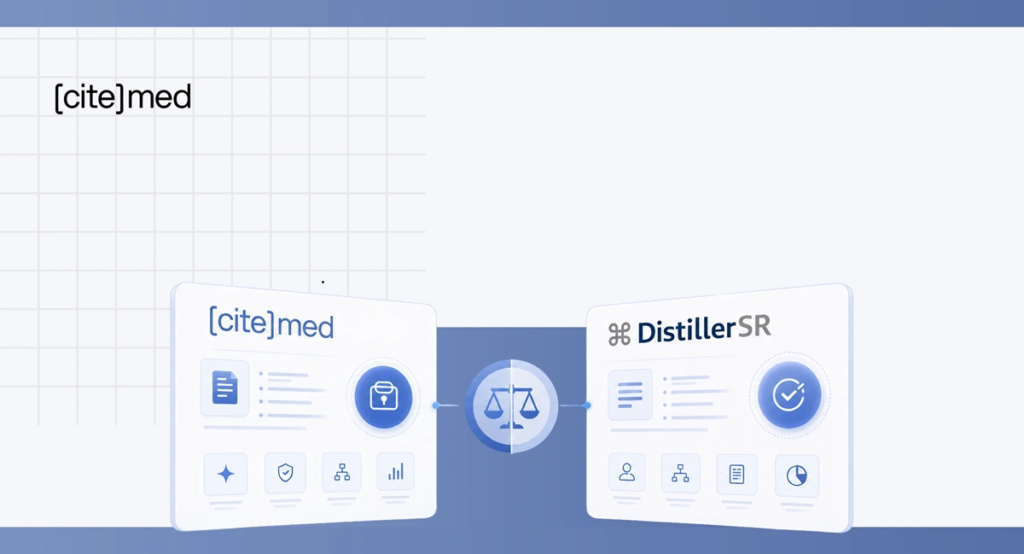


At first glance, platforms such as DistillerSR and solutions like CiteMed may seem to address the same need: supporting the execution of literature reviews. Both offer tools to manage key stages of the review process, including screening, data extraction, and documentation.
In regulatory contexts, however, this comparison extends beyond functionality. Literature review is not a standalone task, but a critical component of a broader evidence framework that underpins clinical evaluation, post-market surveillance, and regulatory decision-making.
The distinction between DistillerSR and CiteMed therefore reflects more than differences in platform capabilities — it highlights two fundamentally different approaches to managing evidence. This becomes particularly important when the literature review is expected to support regulatory submissions, where traceability, consistency, and defensibility are essential.
Despite their differences, both DistillerSR and CiteMed are designed to support the structured execution of literature reviews. At a core level, each solution enables key stages of the review process, including comprehensive literature search across multiple databases – such as PubMed, Embase, and the Cochrane Library – study screening, data extraction, and the maintenance of an audit trail.
These capabilities are essential for ensuring that literature reviews are conducted in a systematic and reproducible manner, particularly in contexts where transparency and documentation are required. However, while the underlying objectives are similar, the way in which these capabilities are implemented — and the broader context in which they operate – differs significantly.
DistillerSR is widely recognised as a configurable, cloud-based platform designed to support the structured execution of literature reviews at scale. It provides a flexible framework that enables users to design and implement customised workflows tailored to specific project requirements.
A key strength of DistillerSR lies in its ability to support large-scale and scalable evidence reviews through highly configurable processes. Users can define screening criteria, develop tailored data extraction forms, and manage extensive volumes of references within a single system. AI-assisted features support abstract screening and prioritisation, significantly reducing screening time and improving efficiency.
DistillerSR also offers a robust audit trail, ensuring that each step of the review process is documented, traceable, and reproducible. The platform captures exclusion reasons during screening, allows for double-checking of exclusion decisions, and enhances accuracy and quality control throughout the review. This level of transparency is particularly valuable in regulated environments. As a result, the platform is widely used across pharmaceutical and medical device organisations, particularly in the context of systematic reviews supporting Clinical Evaluation Reports (CERs) and regulatory submissions.
The platform supports integration with other tools for downstream analysis and data management, enabling organisations to connect literature review workflows with external systems. However, as a platform primarily focused on literature review, broader regulatory activities — such as post-market surveillance, regulatory tracking, and cross-functional evidence management — require additional expertise and oversight to be executed effectively within a regulatory context.
DistillerSR also supports PRISMA-aligned outputs, including the PRISMA Flow Diagram, to ensure transparency and reproducibility in systematic reviews.
In contrast to platform-centric approaches, CiteMed positions medical device literature review within a broader, integrated regulatory evidence ecosystem. Rather than treating literature review as a discrete task, it is embedded within a connected lifecycle that supports clinical evaluation, post-market surveillance, and regulatory reporting – with the clinical and regulatory expertise to ensure those outputs meet the standards required for submission and audit.
Central to this approach is Evidence Cloud, a multi-module platform designed to support the full regulatory evidence lifecycle. This includes end-to-end management of literature reviews for Clinical Evaluation Reports (CERs), Post-Market Clinical Follow-Up (PMCF), and post-market surveillance (PMS), as well as the generation of PRISMA-aligned outputs. The platform prevents extraction of the same information across projects, improving efficiency and accuracy in evidence management.
Where DistillerSR requires external systems or processes to manage broader regulatory activities, CiteMed addresses these directly. Post-market surveillance, regulatory tracking, and cross-functional evidence management are integrated within the same ecosystem – meaning manufacturers do not need to bridge the gap between a literature review platform and the wider regulatory compliance activities that depend on it. CiteMed supports collaboration among multiple teams, ensuring continuous access to up-to-date data and enabling quicker decision-making. This is supported by a team of clinical and regulatory experts who bring the interpretive and analytical capability that platforms alone cannot provide.
A key differentiator lies in CiteMed’s MedTech-native design, which reflects how regulatory workflows are executed in practice. The platform integrates literature review with downstream activities such as vigilance, regulatory tracking, and evidence reporting. Modules such as Vigilance and PathwayAI extend functionality beyond literature review by enabling continuous monitoring, signal detection, and alignment with regulatory requirements. AI capabilities are designed to support — rather than replace — expert judgement, aligning with regulatory expectations around defensibility and transparency.
CiteMed also emphasises traceability across the entire workflow. Rather than maintaining isolated audit trails within individual processes, documentation is carried across modules, enabling a continuous audit trail across the full evidence lifecycle and supporting a unified, validation-ready record of evidence generation. This is further enhanced by the Microsoft Word add-in, which enables direct citation integration within regulatory documents, reducing manual handling and improving consistency.
The ability to reuse validated evidence across projects reduces the need for repeated literature searches and minimises duplication of effort – supporting greater efficiency in environments where multiple submissions or updates are required. As a result, literature review becomes part of a continuous, connected process rather than a standalone activity, underpinned by both the technology and the expertise needed to translate evidence into credible regulatory outputs.
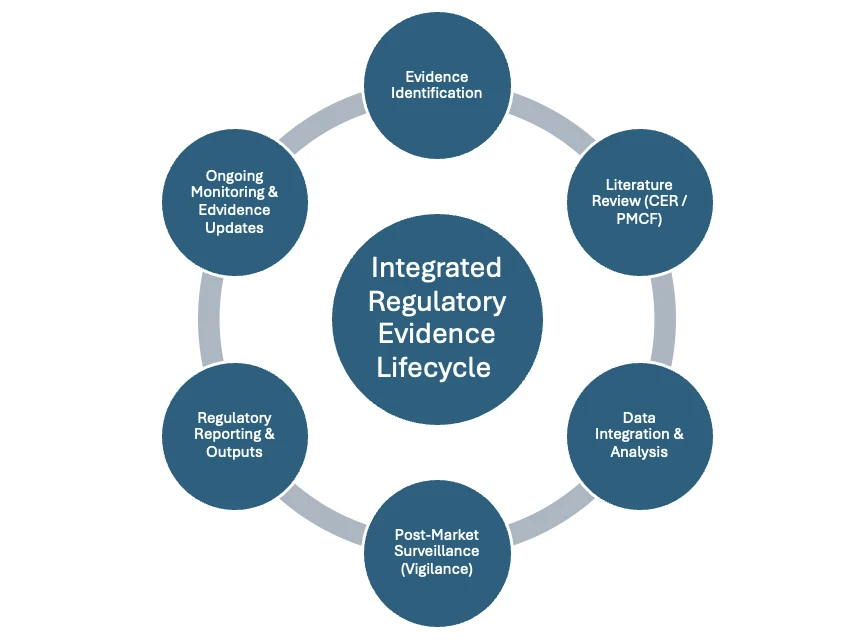
Figure A: Integrated Regulatory Evidence Lifecycle: Illustrates how literature review is embedded within a continuous, interconnected process supporting clinical evaluation, post-market surveillance, and regulatory reporting, with feedback-driven updates across the lifecycle.
Taken together, the distinctions outlined above highlight two fundamentally different approaches to evidence management. While DistillerSR is designed to optimise the execution of literature reviews through structured, platform-driven workflows, CiteMed positions literature review within a broader, interconnected regulatory evidence lifecycle. In this model, evidence generation extends beyond individual processes and is managed as a continuous, integrated system aligned with regulatory requirements.
These differences can be summarized as follows:
| Concept | DistillerSR | CiteMed |
| Focus | Optimising review process | Managing the entire evidence lifecycle |
| Model | Platform-driven | Integrated + expert-supported |
| Scope | Literature review | End-to-end regulatory workflows |
This distinction highlights two fundamentally different approaches: one centered on process optimisation, and the other on lifecycle integration. Conducting a literature review for medical devices is a highly structured process often dictated by regulatory requirements such as the EU Medical Device Regulation (MDR).
While the philosophical distinctions between DistillerSR and CiteMed are important, these differences also become clearly visible in how each approach is applied in practice.
In operational settings, the contrast between a platform-driven literature review tool and an integrated regulatory evidence ecosystem influences not only workflow design but also how evidence is managed, reused, and translated into regulatory outputs.
The following comparison highlights key differences across several practical dimensions:
Table: Key Differences in Practice
| Dimension | DistillerSR | CiteMed |
| Scope | Literature review | Full regulatory lifecycle |
| MedTech focus | Adapted from broader use cases | Native |
| PMS integration | No | Yes |
| Regulatory intelligence | No | Yes |
| Output | Structured review outputs | Submission-ready outputs |
| Workflow | Configurable | Integrated and continuous |
Regulatory bodies expect medical device literature reviews to include both favorable and unfavorable data, not just positive outcomes. The primary goal of a literature review is to establish the State of the Art (SOTA) and demonstrate that a specific device is safe and effective compared to existing alternatives. SOTA analysis establishes the current standard of care by reviewing similar technologies, alternative treatments, and medical field standards.
The practical impact of these differences becomes most visible at moments of regulatory pressure — during Notified Body audits, conformity assessments, or periodic CER updates, where the consistency and traceability of evidence across multiple outputs is directly scrutinised. In these settings, the cost of fragmentation is not simply operational inefficiency, but the risk of gaps in documentation that cannot be easily reconciled under time pressure.
For manufacturers managing ongoing regulatory obligations under EU MDR and IVDR, the question is not only whether a literature review can be executed well, but whether the evidence it generates can be maintained, updated, and aligned across CERs, PMS, and PMCF activities as requirements evolve. This is where the distinction between platform-driven systematic literature review software and an integrated approach has the most direct bearing on compliance outcomes.
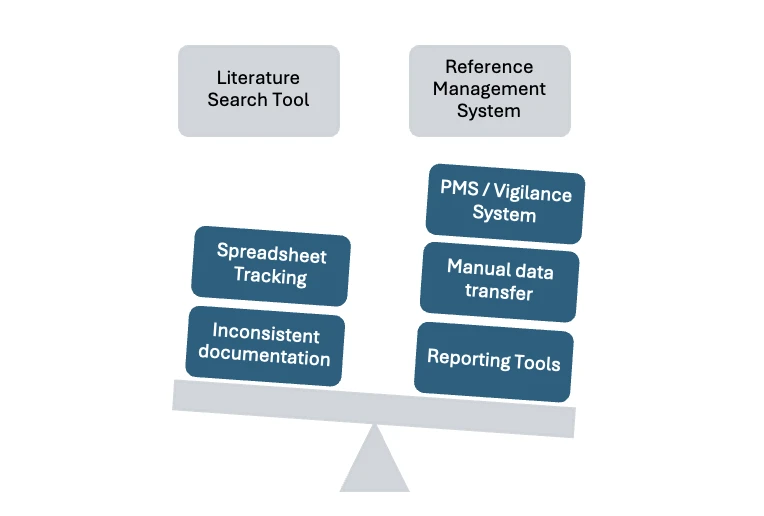
Figure B: Fragmented Evidence Management Across Disconnected Systems
Illustrates how reliance on multiple independent tools can create imbalances in workflow, leading to inefficiencies, manual data transfer, and inconsistencies in documentation.
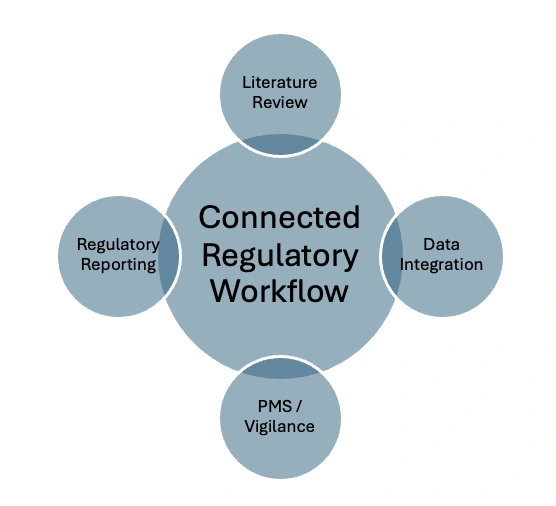
Figure C: Connected Regulatory Evidence Workflow
Illustrates how literature review, data integration, post-market surveillance, and regulatory reporting are linked within a continuous and integrated evidence management process.
For medical device manufacturers operating under EU MDR, this fragmentation is not simply an operational inconvenience — it introduces direct compliance risk, particularly where traceability and consistency across regulatory outputs are subject to Notified Body scrutiny.
In light of these differences, the suitability of each approach depends largely on the context in which it is applied. Both DistillerSR and CiteMed offer clear value, but their strengths align with different operational needs and organisational structures. DistillerSR is widely used in university settings for systematic literature reviews, supporting academic institutions in managing large-scale literature screening and review management.
DistillerSR is particularly well-suited to large-scale systematic literature reviews conducted within academic or research-driven environments. In these reviews, the PICO framework is often used to structure research questions, ensuring methodological rigor and clarity. Its highly configurable workflows and capacity to manage extensive volumes of literature make it a strong option for organisations with established internal expertise and dedicated review teams. In these settings, where the primary focus is on executing comprehensive and methodologically sound reviews, a platform-driven approach can offer both flexibility and control.
In contrast, CiteMed is better aligned with regulatory environments where literature review forms part of a broader, interconnected evidence framework. This includes applications such as Clinical Evaluation Reports (CERs), post-market surveillance (PMS), and Post-Market Clinical Follow-Up (PMCF), where outputs must be continuously updated and aligned with regulatory expectations.
CiteMed is particularly advantageous in time-sensitive projects and audit-heavy workflows, where efficiency, traceability, and consistency across multiple outputs are critical. Its integrated approach supports not only the execution of literature review, but also the management of evidence across the full regulatory lifecycle, making it well-suited to MedTech organisations operating under evolving regulatory requirements.
In regulatory environments, literature review extends beyond a discrete task and instead forms part of a structured process that underpins clinical evaluation across the product lifecycle. As such, the focus is not on selecting a particular tool, but on how evidence is managed, connected, and translated into regulatory outputs.
Understanding the differences between platforms such as DistillerSR and solutions like CiteMed requires a shift in perspective. While both support the execution of literature reviews, they reflect fundamentally different approaches to evidence management – one centred on optimising individual processes, and the other on integrating those processes within a continuous regulatory framework.
This distinction not only influences efficiency but also traceability, consistency, and alignment across evolving regulatory requirements. Approaches that support continuity across the evidence lifecycle are better positioned to meet the demands of modern regulatory environments, where information must be continuously updated and reconciled across multiple outputs.
The choice between platforms such as DistillerSR and solutions like CiteMed reflects a broader decision: whether literature review is managed as a standalone process, or as part of a connected regulatory evidence ecosystem. As regulatory requirements continue to evolve, approaches that support continuity across the evidence lifecycle are increasingly aligned with modern regulatory expectations.
If you are evaluating your approach to literature review and regulatory evidence management, Citemeds can help you understand which solution best fits your requirements. Get in touch to discuss your needs.
Several platforms support systematic reviews, including DistillerSR, Covidence, Rayyan, and Endnote. In medical device regulatory contexts, the choice of software should be guided by the need for audit trails, PRISMA-aligned outputs, and compatibility with regulatory workflows. CiteMed is specifically designed for medical device manufacturers, integrating systematic literature review within a broader regulatory evidence lifecycle that supports CERs, PMS, and PMCF activities.
The best tool depends on the context. DistillerSR is well-suited to large-scale systematic reviews in academic or research settings where configurable workflows are the priority. For medical device manufacturers operating under EU MDR, a solution that integrates literature review with clinical evaluation, post-market surveillance, and regulatory reporting — such as CiteMed — is better aligned with the ongoing compliance demands of a regulated environment.
Rayyan offers a free tier that supports basic screening and collaboration for systematic reviews. It is primarily used in academic research settings. For medical device manufacturers with regulatory compliance requirements, Rayyan lacks the audit trail depth, PRISMA documentation, and regulatory workflow integration required under EU MDR.
Both Rayyan and Covidence are designed for academic systematic reviews. Rayyan offers a free option with basic collaboration features, while Covidence provides more structured workflows and is widely used in Cochrane reviews. Neither platform is specifically designed for medical device regulatory contexts, where requirements for traceability, regulatory intelligence, and integration with post-market surveillance activities go beyond what either tool provides.
AI tools can support specific stages of the literature review process — such as screening, prioritisation, and summarisation — but cannot replace expert judgement in regulatory contexts. Under EU MDR, literature reviews must demonstrate critical appraisal of clinical data, assessment of methodological quality, and synthesis of evidence into a defensible clinical argument. AI capabilities are best used to support efficiency, not to substitute for the clinical and regulatory expertise that regulatory submissions require.
ChatGPT and similar large language models can assist with drafting, summarising, and structuring content, but are not suitable as the primary tool for regulatory literature reviews. They lack access to live databases, cannot conduct systematic literature searches across PubMed or Embase, and do not produce the traceable, reproducible outputs required under EU MDR. In regulated environments, AI tools should be used as supporting aids within a structured, expert-led review process.
The 5 C’s of literature review are Cite, Compare, Contrast, Critique, and Connect. In medical device regulatory contexts these principles translate directly into practice — citing relevant clinical data from multiple databases, comparing evidence across equivalent devices, contrasting favourable and unfavourable findings, critically appraising study quality, and connecting evidence to specific safety and performance claims within the Clinical Evaluation Report.
The four main types of literature review are systematic reviews, narrative reviews, scoping reviews, and meta-analyses. In medical device regulation, the systematic review is the gold standard — required under MEDDEV 2.7/1 Revision 4 and EU MDR to ensure that clinical evidence is identified, appraised, and synthesised using a transparent and reproducible methodology.
Literature reviews, CERs, post-market surveillance — in one platform.